Keen Eye: Patrick Rychner
Published on 01 December 2025
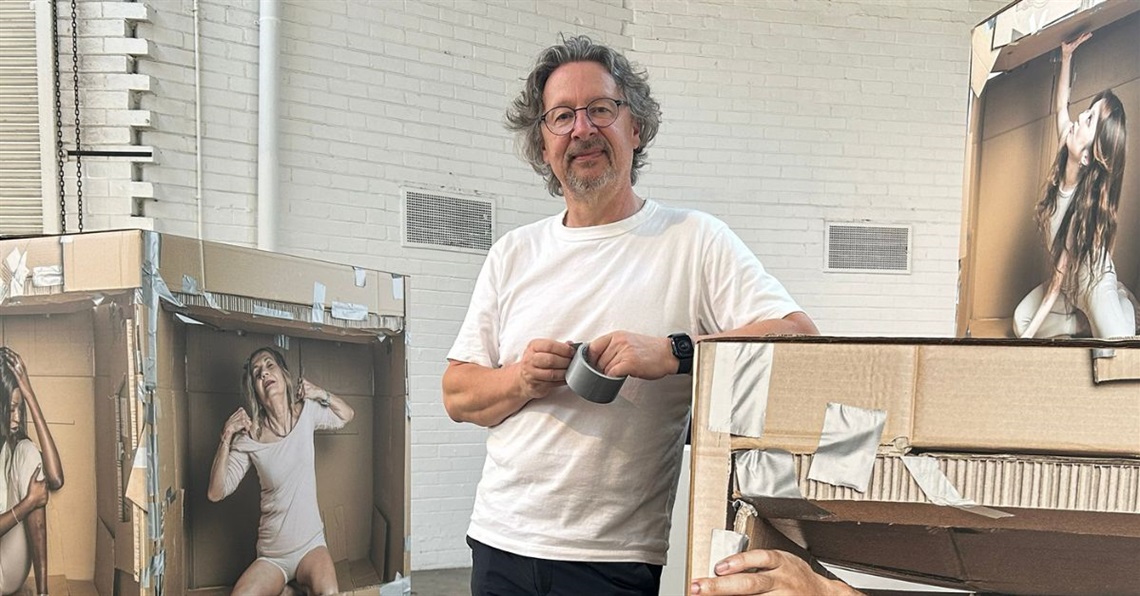
Red Hill photographer, Patrick Rychner, sees the world through a humanist lens. In his installations and exhibitions, he draws viewers into a space of quiet, considered contemplation tackling difficult subjects like loneliness, isolation, displacement and the juxtapositions of nature and society, stillness and unease. Photography is his way of making sense of the world.
Art and nature have always been Patrick’s sources of inspiration. He was born in Switzerland and grew up on the shores of Lake Zurich. Hard to imagine a more inspiring backdrop for a budding visual artist. As a child, Patrick fuelled his fertile imagination reading, drawing and painting.
While his father worked in finance, he was also a talented hobby photographer with a keen eye for light, framing and tone. He used a Yashica 6x6 medium format camera. Patrick and his brother were their father’s favourite subjects so
Patrick had plenty of exposure to photography in front of the lens before stepping behind it.
It wasn’t long before Patrick had his own camera. At eleven, he was gifted his first 35mm camera – a Minolta SLR. Three years later, he got a Canon A1 and he’s been using that brand ever since. His early observations in photography instilled in him a strong sense of how to see the world in light and composition.
He went to art school completing an apprenticeship in graphic design. Later, he became art director at Young & Rubicon in Switzerland. Travel in his early twenties changed his trajectory when a different love appeared. Patrick met his Australian wife, Robyn, while travelling in Ecuador. Her Rosebud origins brought them back to the Mornington Peninsula.
Patrick didn’t study photography formally until COVID lockdowns when he enrolled at Melbourne’s Photographic Studies College earning an Advanced Diploma in Photography. He left a successful decades long career as a creative director to pursue his new calling as an art photographer.
Until February 14, Frankston Arts Centre features Patrick’s Bloomastics exhibition which pairs plastic waste with vibrant flowers. “The idea was to create awareness about how we are disconnected from nature physically and emotionally. We romanticise nature while simultaneously exploiting it. Bloomastics reflects this tension. Each piece is designed to captivate visually before transforming into a catalyst for reflection and conversation,” he says.
In April next year Patrick has another FAC exhibition, Societal Exits, inside Cube 37’s Glass Cube. It’s an intriguing exploration of loneliness. His subjects occupy specially made oversized cardboard boxes. The models shared their own stories about loneliness before Patrick filmed each of them adding personal box embellishments. He then photographed the models inside their boxes and applied those life-sized photographs to the finished boxes.
"The idea was to visually represent an emotion that is often invisible. A cardboard box is a contained empty space that amplifies feelings of hollowness, disconnection. These womb-like spaces make the intangible tangible,” he says.
“I try to create work that provokes awareness around social issues. Loneliness is one of the most pervasive issues of our time transcending sex, age, culture and geography. It’s paradoxical that we live in an era of hyper connectivity, yet so many people feel profoundly disconnected. Emigrating from overseas, starting from scratch and building new social networks was not easy for me. I felt lonely occasionally and still do at times,” he says.
Photography helps Patrick make sense of the world. It forces him to focus on one thing at a time – to be present and deliberate - to think about what he wants to say and how to communicate it in a single frame or series where an image(s) must work without explanation.
His goal is to keep pushing how photographic work can tell deeper, more resonant stories, to explore projects that challenge perceptions and address societal and environmental issues like fragility, displacement, transition, resilience and vulnerability in unexpected, visually engaging ways. He’s drawn to scenes that hold an underlying tension – where stillness feels charged, expressing a pervasive contrast between serenity and unease.
“I’m particularly interested in creating work that sits between photography and installation where the viewer becomes part of the experience, not just an observer. I want to develop images that linger in people’s minds long after they’ve left the gallery,” he says.
ANDREA LOUISE THOMAS